

Phoenix Project
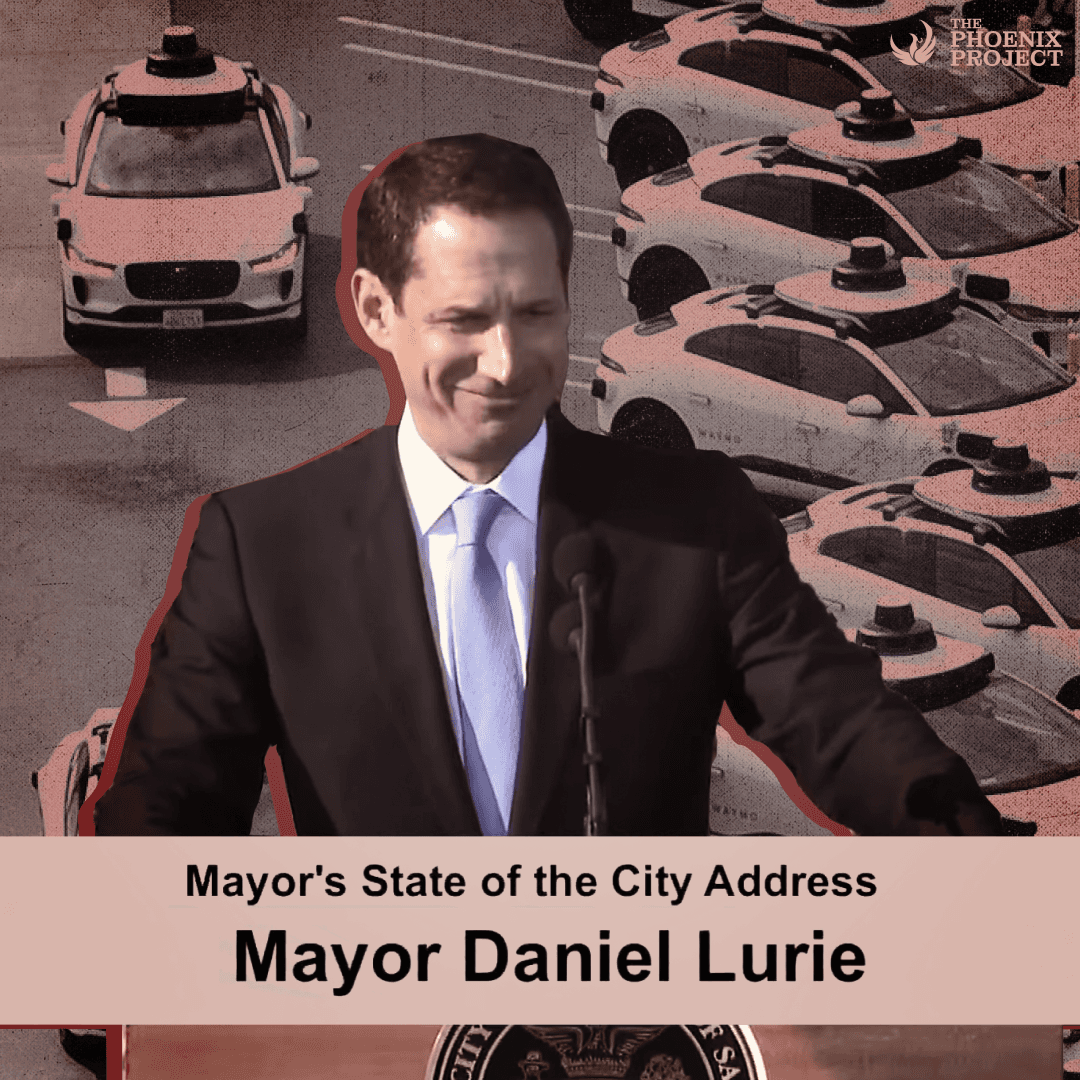
Mayor Daniel Lurie delivered his first state of the city address last week, using the occasion to deviate for a moment from his usual promise to combat a non-existent crime wave by sending more police onto mostly quiet city streets. Instead, Lurie took a page from recently elected New York Mayor, and political phenomenon, Zohran Mamdani, announcing his intention to make the city more affordable for working families.
Undermining the mayor’s message was the group sitting behind the Lurie family, among them the city’s wealthiest, including billionaires Chris Larsen, the chairman of cryptocurrency firm, Ripple Labs, and Michael Moritz, the tech investor who bankrolled now-defunct Astroturf Network group TogetherSF and online media outlet San Francisco Standard. Joining them were representatives from other Astroturf Network groups including GrowSF and ConnectedSF, and right-wing political players including real estate developer Nick Podell, SPUR’s Sean Elsbernd and harm-reduction foe Tom Wolf as well as executives from and lobbyists for the city’s business community.
To date, Lurie’s special guests have shown little interest in easing the challenges facing working San Franciscans in one of the most expensive cities in the world. Almost all have opposed any attempt to tax corporations to support city services, and are enthusiastic boosters for the Mayor’s plan to upzone large swathes of the city, a boon to real estate developers, but one that will do little to create affordable housing.
Lurie unveiled a plan to expand subsidies that give a family of four earning less than $230,000 a year free child care. Those making up to $310,000 will be eligible for a 50% subsidy. The money will come from funds from Proposition C, a successful 2018 ballot measure taxing businesses with more than $50 million in yearly revenue to fund homeless services and childcare. Prop C raises an estimate $250 million to $300 million annually. This proposal will help some middle class families but will not do more than that.
Few of Lurie’s special guests supported Prop C. Moritz, a former journalist, wrote an opinion piece condemning the measure in the Wall Street Journal. Most are likely opposed to the so-called Billionaire’s Tax, a proposed statewide measure to levy a 5% tax on billionaire’s assets for a period of 5 years.
Lurie has also come out against the Billionaire’s Tax. Keally McBride, a politics professor at the University of San Francisco, believes the Mayor is worried about alienating the city’s wealthy to whom he is close. “He thinks about billionaires as local resources,” McBride said, but, as a product of immense privilege himself, the Mayor may feel a kinship with San Francisco’s wealthiest.
So far, Lurie has been quiet on whether or not he’ll support a San Francisco measure, led by Supervisor and Congressional candidate Connie Chan, that would tax ride-sharing services and the most lucratively compensated chief executives to compensate for revenue drops as a result of President Donald Trump’s federal budget. According to the city, Trump’s so-called Big Beautiful Bill will cost San Francisco as much as $310 million a year by 2027 from direct cuts to federal programs that return tax revenue to the states, and also from new federal rules that are intended to make it harder for low-income individuals to access welfare programs. That loss will go up to $400 million by 2038.
Hoping to add his voice to a national conversation about affordability, the scion of the billion-dollar Levi Strauss fortune claimed to feel the pain of ordinary San Franciscans. “When tech booms, opportunity grows, but so does anxiety about rising rents, displacement, and a boom-and-bust cycle that has historically left too many people behind,” Lurie told the crowd at the Richmond District’s Rossi Playground.
The pain is acute. The city’s rents are soaring. In the year between September 2024 to 2025, rents jumped 12%, making it the greatest increase experienced in any American city. There’s been a commensurate increase in evictions now at a 10-year high. For workers earning minimum wage, that means a modest studio apartment is out of reach. Adding to tenant woes is the Mayor Lurie Family Housing plan which will see the demolition of rent-controlled units.
Public transportation continues to struggle in no small part because of the Mayor’s actions. Lurie has slashed MUNI lines and increased fares while opening the door for Waymos to take over car-free Market Street. The average one-way trip in a Waymo is $20, more than the hourly minimum wage in SF.
Meanwhile, grocery stores and pharmacies are vanishing from underserved neighborhoods, including the Safeway in the Fillmore, Lucky in Bayview, Central Drug in the Excelsior, and all the Rite Aids during a period of growing economic desperation.
A subsidy for childcare, while laudable, is a small step toward making the city more affordable for working San Franciscans. If Daniel Lurie truly wants to be the Affordability Mayor he must make his fellow billionaires pay their fair share to support a city that’s made them obscenely rich.