Ian Firstenberg
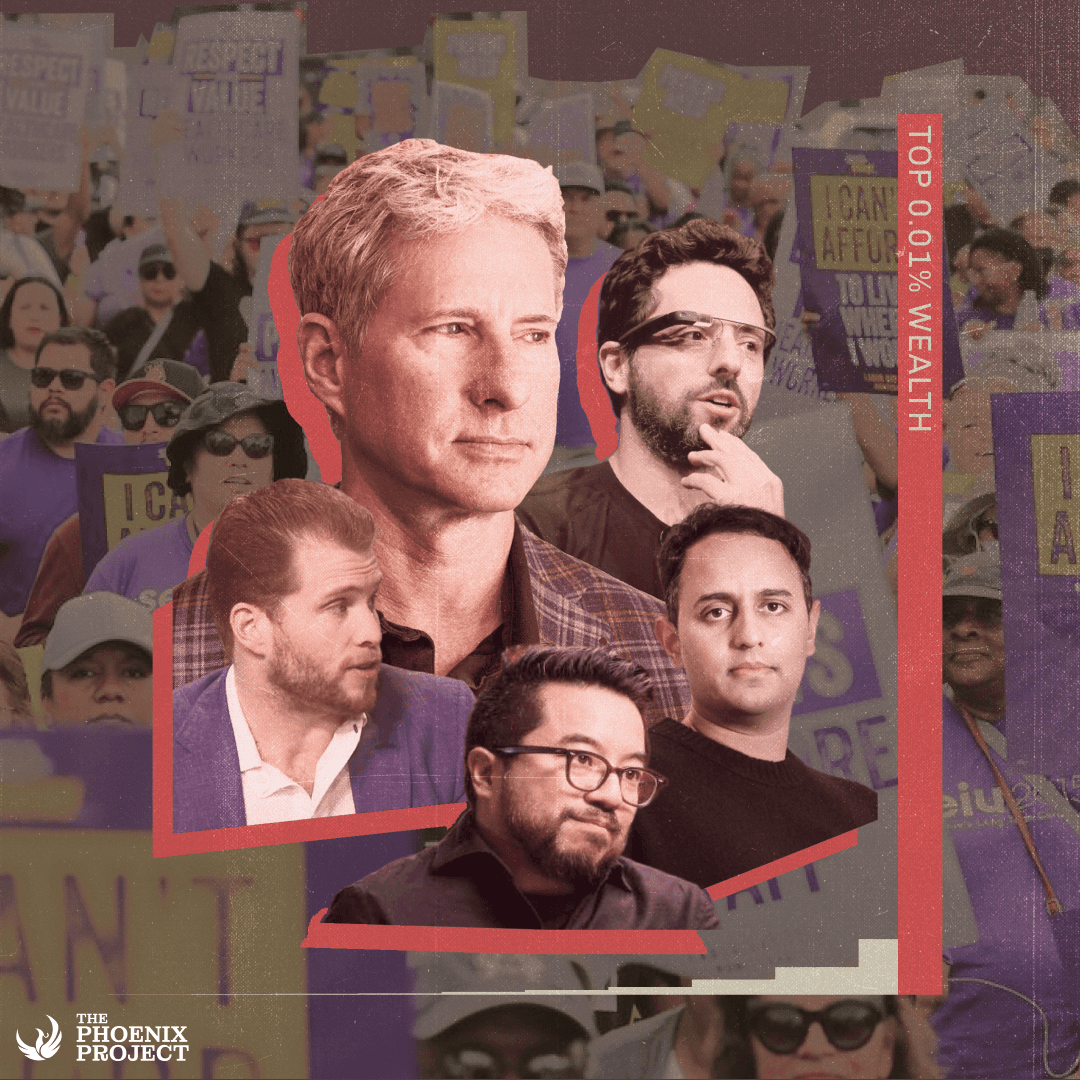
California has roughly 200 billionaires, many of whom have been using their massive wealth to buy political power. They’ve bankrolled local, state and national candidates, collectively spending millions to push San Francisco, and the state, to the right.
An initiative, sponsored by a coalition of labor unions, on California’s November 2026 ballot has these billionaires up in arms and has energized at least one who had previously preferred to remain on the sidelines, into the political fray. The measure calls for a relatively small tax on residents with a net worth of more than a billion dollars.
The Billionaire Tax Act, sponsored by United Healthcare Workers West, would enact a onetime 5% tax on the state’s wealthiest. The tax would be levied on anyone with a net worth of more than $1 billion. The money would cover the devastating cuts to state services from President Donald Trump’s One, Big Beautiful Bill. Most of the money would be used to save California's healthcare system from collapse. It would also fund K-12 education and food assistance programs. Over the next five years, the state is facing federal funding cuts that will strip roughly $100 billion from California’s healthcare system alone.
Despite the modest intentions of the tax and the worthiness of the services it intends to fund, the Billionaire Tax Act has galvanized class solidarity among the state’s billionaires. It should be noted that this tax would in no way change the lives of these billionaires or their descendants for many generations. For example, a billionaire with a net worth of $2 billion would have to survive on only $1.95 billion.
At a recent gathering of the Bay Area Council, Chris Larsen, chairman of crypto firm Ripple Labs, issued what can only be described as a rallying cry: “We have to stop this antibusiness bullshit that we’ve been living with for far too long,” Larsen said. “All of us have to be prepared for a permanent political fight.”
The attempt to force billionaires to pay a fraction of their fair share, has prompted a flurry of activity. Millions are being poured into political action committees with anodyne names and overlapping donors, many of whom are longtime business acquaintances from Silicon Valley. Not only are they funding PACs to oppose the tax, they have spent lavishly to support San Jose Mayor Matt Mahan’s moribund gubernatorial race. Mahan has already voiced strong opposition to the tax.
The following are those leading the Billionaire Tax revolt.
Chris Larsen
Larsen has been a political donor locally and nationally. Although he calls himself a political moderate, Larsen has backed conservative causes in San Francisco, notably Proposition E which weakened civilian oversight of the long-troubled San Francisco Police Department. He has been an enthusiastic booster of online surveillance, donating $9.4 million to the SFPD’s Real Time Investigation Center (RTIC).
Nationally, Larsen’s company, Ripple, helped create Fairshake, a SuperPAC that supports pro-crypto currency candidates. Fairshake spent a staggering $10 million to thwart the senatorial campaign of former Congresswoman Katie Porter in the March 2024 California primary. Porter has called for industry regulation. It has poured more than $133 million in 2024 campaigns, the vast majority on Republican candidates, and has $165 million of cash on hand.
Earlier this year, Larsen, and third-generation venture capitalist Tim Draper, created Grow California, claiming to have $40 million in promised donations. Larsen said he will personally contribute $30 million.“Whoever designed that wealth tax in the unions — wow,” Larsen said. “They woke up the sleeping giant like I have never seen. That’s maybe the blessing of this whole thing.”
In fact, many of those who have become politically energized have long been involved in politics. Among them are billionaires Michael Moritz, a staunch opponent to taxes, and Peter Thiel, a longtime supporter of President Donald Trump.
Larsen is spending liberally to defeat the tax. He is among the donors to Building a Better California, a PAC formed by Google founder and former Alphabet president, Sergey Brin, who seeded the group with $20 million. A portion of the money will be used to fund a big-money campaign against the Billionaire Tax Act. He has also made a $500,000 contribution to the California Business Roundtable’s issue PAC. The Business Roundtable’s largest contribution has been $3 million from Thiel. Larsen gave $5 million to Golden State Promise, a PAC created explicitly to oppose the Billionaire Tax Act that is staffed by consultants from Fairshake. Ripple added another $5 million.
Sergey Brin
While Larsen has become a fixture on the political scene, Brin is a relative newcomer. The money he spent to start Building a Better California represents his first sizable campaign contribution.
According to recent reports, Building a Better California will fund three separate ballot measures to block the Billionaire Tax Act. Should any of them win, the tax would be defeated. Larsen is not the only billionaire who’s contributed to Brin’s PAC, former Google Chief Eric Schmidt, tech investor Michael Moritz, who bankrolled the now defunct conservative political pressure group TogetherSF, and venture capitalist John Doerr. All three have given $2 million.
Like many in the tech industry, Brin, who ostensibly left California for Nevada at the end of last year to avoid paying the tax, has, until recently, pursued a politics of self-interest. He has contributed to Mahan’s gubernatorial campaign and Republican Steve Hilton’s.
According to a recent New York Times article, Brin’s self-interest has hardened into ideology. Brin, who once backed liberal causes like same-sex marriage and donated to former President Barack Obama’s 2012 re-election bid, has moved rightward and wants to move the Golden State that direction as well. The reason, the Times reported, is due to the influence of his partner, Gerelyn Gilbert-Soto, an enthusiastic Trump supporter, as well as his experience in the former Soviet Union.
"I fled socialism with my family in 1979 and know the devastating, oppressive society it created in the Soviet Union,” Brin told the Times. “I don’t want California to end up in the same place.”
As his politics have become more conservative, Brin has become disenchanted with Mahan, who recently visited his compound seeking a follow-up to a previous $1 million contribution, one that was not forthcoming. To remain in the billionaire’s good graces, Mahan is said to have apologized to Brin for attending a recent No Kings rally.
Joe Lonsdale, Neil Mehta and Garry Tan
Joe Lonsdale, Neil Mehta and Garry Tan are the animating forces behind California Renewal, a potentially nine-figure political fund being pitched to Silicon Valley’s wealthiest. As opposed to PACs which have stringent disclosure requirements, funds and independent expenditures do not and thus are excellent vehicles for billionaires who wish to remain anonymous.
Lonsdale and Mehta are billionaires. Lonsdale is a member of the PayPal Mafia, a group of early employees from the storied online payment scheme. As an undergraduate, he volunteered at the Stanford Review, a conservative newspaper founded by Thiel. After a stint at PayPal, he went to work for a Thiel hedge fund and later founded Palantir, which makes online surveillance systems for the military. Thiel and the Central Intelligence Agency were among two of the company’s early investors. A Republican, he has been an active donor to right-wing candidates and causes. In 2020, he left California for Texas, saying that he had been driven away by the state’s high taxes.
Mehta is a tech investor who has purchased blocks on the Fillmore Street commercial corridor, pushing out longtime businesses.
Garry Tan is no stranger to those following San Francisco politics. Tan is a centimillionaire who has, until recently, spent relatively little on political campaigns. That said, he has been among the most vocal of the politically-interested tech elites, using his widely followed X/Twitter account to push his political views. Tan’s volatility landed him in trouble when he called on seven members of the Board of Supervisors to “die slow, motherfuckers.” After briefly disappearing from public view, Tan roared back with a flattering profile in the New York Times.
As chief of Y Combinator, the world’s largest incubator of technology startups, Tan has been in a unique position to organize disgruntled tech elites. He joined the board of Astroturf Network group GrowSF before going on to found Garry’s List, which he describes as a “Rotary Club for radical centrism.” Tan’s “centrist” beliefs include increased policing and the criminalization of homelessness. The launch for Garry’s List featured a who’s who of political dark money in the Bay Area including Larsen, who used the occasion to deliver a fiery attack on gubernatorial candidate Porter for her support of the San Francisco Overpaid CEO Tax, an initiative on the June 2026.
Tan recently told SF Standard that he hoped Garry’s List would recreate some of the “energy that I felt when we were first working on the recall of Chesa Boudin and the School Board.” The ouster of three left-leaning members of San Francisco’s Board of Education followed by that of progressive District Attorney Boudin marked the first significant wins for the Astroturf Network.
Politics as Investing
Progressive wins at the ballot box between 2015 and 2020 served as a wake-up call for San Francisco’s business elite, and the Astroturf Network set up an array of political vessels to achieve their policy goals.
That investment in local politics has garnered these men lofty returns with San Francisco moving to the right since those 2022 recalls. “We need to think about politics more like we think about investing,” Tan said in a March, 2026 Bloomberg interview.
They’re now trying to leverage their returns from investing in municipal politics, into an investment in state politics. The statewide playbook is largely the same as it is in San Francisco: set up various PACs, independent expenditures or funds to support their policy objectives. Said objectives are broadly aimed at defunding or privatizing any of California’s social services and opposing any taxation, no matter how negligible compared to their outlandish ill-gotten gains.
Progressive victories like Proposition C, which instituted a commercial tax on big businesses to fund homeless services were instructive for the Astroturf Network. That began a backlash that led to the aforementioned recalls of progressive District Attorney Chesa Boudin and three members of the city’s School Board. After those heady wins, they sought to fully capture San Francisco by funding former San Francisco Supervisor Mark Farrell’s campaign in the 2024 mayoral race.
Farrell was defeated as was Proposition D, a ballot initiative backed by the city’s elites which sought to centralize power in the mayor’s office. Briefly, it appeared they were defeated: Moritz, who spent nearly $10 million in the 2024 election, folded TogetherSF, the political group he largely bankrolled to push conservative candidates and causes.
With the governor’s race up for grabs and a national election just two years away, the billionaire class is setting aside any petty squabbles to organize in their long term interest, drawing inspiration (of a sort) from organized labor, as Larsen recently explained.
“We’ve got to start fighting on par with the unions when they propose these absolutely stupid propositions like this crazy CEO tax, or when they try to ban delivery drones or when they try to tell us that doing business in the city is a privilege,” Larsen said.
Ian Firstenberg is a life-long East Bay resident and a long-suffering Warriors fan. He writes about labor, surveillance, tech money, voting trends, public banking and local politics for publications like 48Hills, El Tecolote and others.