

Exavier Morrison Wells
Now that we are removed from the despotism of the last century, there is a tendency to deny the signs that signal the beginning of fascistic policy. The notion that the technocrats who influence and run our city are essentially benign is the result of careful branding, one that allows voters to become blinded to the more authoritarian possibilities present within the city government.
It is important to see past the “moderate” veneer and into the deeply troubling ideology beneath it. To see how this ideology expresses itself in our contemporary system, look no further than that latest attempt to rewrite San Francisco’s foundational structure.
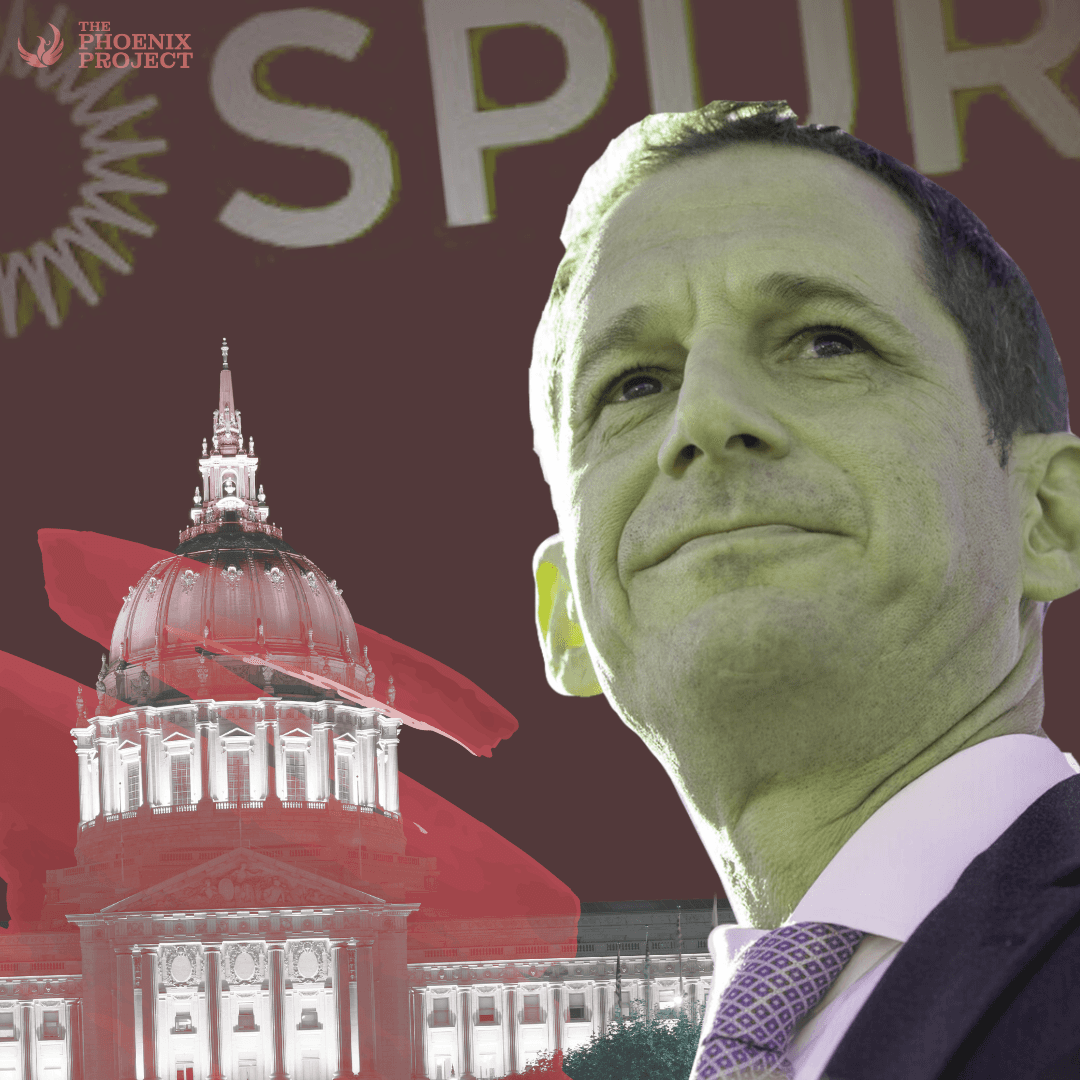
The recently introduced SPUR “Charter for Change” is not, as many have claimed, a minor tweak to better grease the wheels of local government. It is fundamentally a blueprint to strip San Francisco’s governance of democratic friction, and remake the city to allow unchecked executive rule.
Consider this: Under current rules the mayor can directly appoint only 4 out of 63 department heads, or roughly 6%. The rest are under commission control, board appointment, or direct election. The charter proposal would transform that ratio: From near-nonexistent mayoral hiring power to full authority that allows the city’s chief executive to hire and fire almost every department head. In practice, it would be less an exercise in efficiency and more a rapid escalation of power away from public oversight toward executive power.
The proposed elimination or radical weakening of dozens of existing commissions grants the mayor further power. It would collapse scores of charter-established boards from libraries, environment, arts, small business, juvenile justice and public health, and downgrade them (or dissolve them) so that they no longer hold decision-making power. Their advisory status would be subject to the whims of executive-appointed leadership. Commissions once created through popular vote or community advocacy, and functioning as real powers of oversight and representation would be replaced by a thinner set of increasingly compliant agencies.
Ballot initiatives — the oldest tool of direct democracy in this city — are also under threat. The charter revision would raise signature thresholds, effectively making it harder for working-class neighborhoods, community groups, or grassroots voters to place issues directly before the people. Meanwhile, central operational rules — purchasing, capital planning, departmental reorganization — would be shifted from the public charter into administrative code where they can be changed without referendum or public oversight. Again, it is important to understand that these are not discrete reforms; they represent the reorientation of our city government into a structure where decisions are hidden behind executive prerogative, and the public becomes merely spectators rather than participants.
If politics require that oversight boards be declared “clutter,” that citizen ballots be made harder to qualify, and that mayors hold sweeping appointment powers, then the government is not being redesigned for effectiveness. Rather, it is refashioning the government so that the executive branch can rule by fiat and without public interference.
A consistent feature of San Francisco’s technocratic politics — and one that reveals its deeper ideological loyalties — is an obsession with action for its own sake. The idea that a problem not yet “acted upon” is a moral failure, that hesitation is a form of decadence, and that deliberation is nothing less than obstruction. That notion is furthered in Pirate Wires’ insistence that the city is finally “moving again;” in the Abundance movement’s endless appeals to “speed,” “urgency,” and “unblocking;” and in the now-routine accusation that democratic process is the enemy of progress. That worldview collapses governing into the art of performance and into the visible assertion that any action regardless of its efficacy is progress.
Fascism scholar Umberto Eco wrote that proto-authoritarian movements begin with the conviction that action holds intrinsic virtue and that contemplation is a sign of decay. The structure and use of power resonates in San Francisco’s political power dynamics. Here, the “cult of action” emerges through an often managerial lexicon: Slowness is failure, dissent is obstructionism, and harm inflicted in the name of action is justified because the city “can’t afford to wait,” regardless of consequence.
And when that ethic is aligned with material data, the picture comes into focus. San Francisco has just achieved the steepest poverty rate in the Bay Area, at 17.5%, according to Tipping Point and census data. Meanwhile, San Francisco’s technocrats say the city is “roaring back,” buoyed by AI investment and a new class of “builders” fixing what politics allegedly broke. The contradiction here is not coincidental. The cult of action requires a narrative of rebirth, and narratives of rebirth always demand sacrifice. The suffering of the poor becomes proof that the status quo is not “moving” fast enough rather than evidence of a system failing, but of a system insufficiently streamlined.
The Abundance movement operationalizes this worldview. Its leaders argue that the central obstacle to prosperity is not inequality, not speculative capital, not the structural violence that produces homelessness, but the democratic process itself. Lengthy permitting, community opposition, ballot measures, environmental review are cast as illegitimate brakes on a future that must arrive more quickly, almost pathologically,for its purveyors. And whenever a person or neighborhood stands in the way, they are classified not as constituents but as impediments to inefficiencies that must be cleared. This is Eco’s “popular elitism” in its purest contemporary form: A self-anointed class convinced it alone recognizes the future and that the public, if allowed to intervene, will ruin it.
The Lurie administration functionally fits seamlessly into this ethic. Its reflexive use of policing, despite all available evidence contradicting its long-term efficacy, reflects a governing philosophy not of thoughtful problem solving but of visible action for its own sake. Force is fast, housing is slow; sweeps are fast, services are slow. The point is not whether these actions work, but whether they are seen. The speed with which they can be pointed to is mistaken, disastrously, for their moral legitimacy.
Politics like this inevitably drift toward authoritarianism because it has already chosen its specific set of enemies. They are those whose existence is thought to slow the city down: The poor, the sick, the unhoused, and the dissenters, anyone who refuses to snap into the rhythm demanded of them. In a worldview that worships acceleration, these people are no longer constituents; they are a drag. And once the weakest are determined as the reason the city cannot move efficiently, then a threshold into a much darker form of politics has been crossed.
Exavier Morrison Wells is a legal fellow at the Phoenix Project, where he investigates how authoritarian systems cloak themselves in law, nonprofits, and procedural legitimacy. He writes about American fascism, political compliance culture, and the slow, quiet collapse of democratic infrastructure. To read more of Exavier’s writings, subscribe to his Substack: Substack.com/@exaviermorrisonwells